 JOURNAL OF MAGNETICS
JOURNAL OF MAGNETICS
- pISSN : 1226-1750
- eISSN : 2233-6656
Journal of
Magnetics
Magnetics
Open Access
Quarterly
- pISSN : 1226-1750
- eISSN : 2233-6656
Editor's Choice
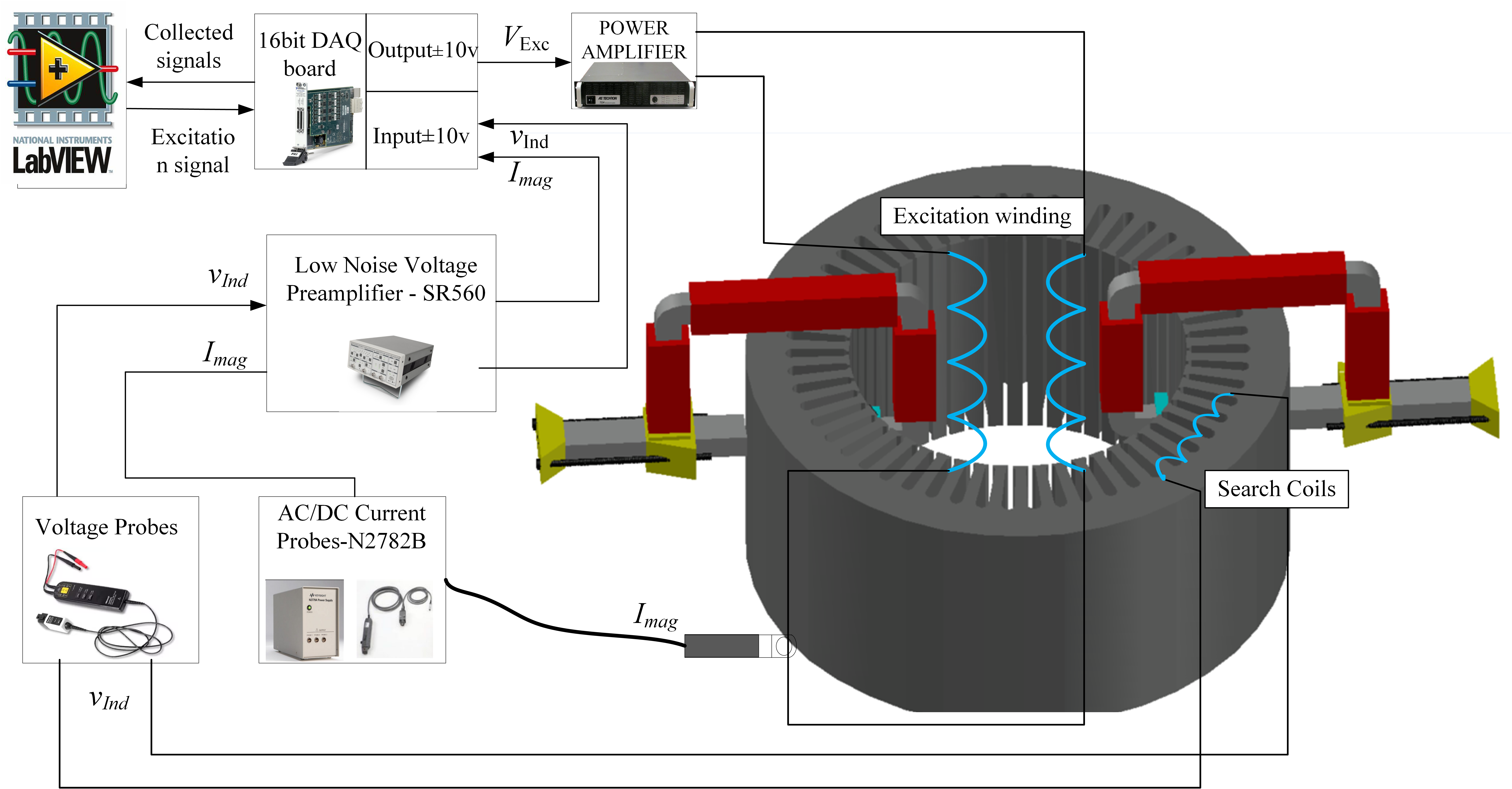
Local Loss Evaluation of Assembled Stator Cores for Electric Vehicles
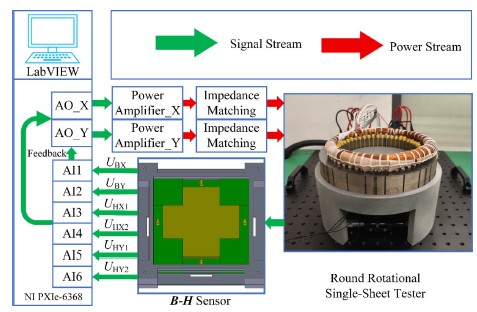
The magnetic properties of the motor stator core exert a direct influence on its operational efficiency, with residual stresses introduced during the manufacturing process identified as critical factors affecting core losses. Traditional one-dimensional magnetic characterization methods are limited by the complex geometry of the stator. This limitation prevents their direct application for evaluating the local magnetic properties of the assembled core, thereby hindering research into the mechanisms influencing residual stresses on iron loss. To address this limitation, a novel local loss tester was designed and implemented. Following validation of its feasibility through finite element simulation, the device was employed to systematically measure the loss distribution across different depths and magnetization directions within the core under alternating magnetic fields. These measurements revealed axial loss variations attributable to the inherent magnetic anisotropy of non-oriented silicon steel sheets. Comparative studies indicated that traditional one-dimensional methods may introduce measurement deviations as high as 25%. A significant reduction in core losses (approximately 20%) was observed following stress-relief annealing. The effectiveness and reliability of the device were confirmed (relative standard deviation <1% in repeatability tests). This research provides key experimental evidence for the precise assessment of residual stress effects and optimizing stator core design and manufacturing processes.
Current Issue - Vol.31 No.2
Journal of
Magnetics
Magnetics
Open Access
Quarterly
- pISSN : 1226-1750
- eISSN : 2233-6656




Highlight
- Local Loss Evaluation of Assembled Stator Cores for Electric Vehicles Vol.31 , No.2, 2026, pp.250-258
- Evaluation of Spin-Orbit Torque Efficiency in Ta/CoFeB Bilayers with Out-of-Plane and In-Plane Magnetizations Using Harmonic Hall Measurements Vol.31 , No.1, 2026, pp.21-34
- Magnetic Field–Based Dose Modulation in Diagnostic Radiology: A Feasibility Study Vol.30 , No.4, 2025, pp.837-841
Editorial Office
- Tel. +82-2-3452-7363
- Fax. +82-2-3452-7366
- E-mail. office@magnetics.or.kr